

A good form should look sharp, practical, and intentional. It should feel like you’re doing real martial arts, not just copying choreography, not “dancing,” and not moving just because someone told you what comes next.
This matters in Chinese martial arts, especially Southern Shaolin, because the forms are often long. Some have over 100 steps, some even 200+ steps. With that many movements, it’s easy for beginners to get lost and end up only memorising the order without understanding what’s happening.
So how do you make a long Kung Fu form look like you actually know what you’re doing? The goal isn’t just to finish the sequence. The goal is to hit the right moments with the right intent, so every move has a clear purpose. If you can improve a few key elements, your form will immediately look cleaner, stronger, and more “alive.”
Why Are Forms So Long in the First Place?
First, it helps to understand the history behind these movements.
- Practical Fighting Usage: In older times, movements came from effective ways to strike and defend, sometimes inspired by animals, which became short, functional combinations.
- Building a Library: Later, these combinations were connected and standardised into longer forms so students could learn a bigger library of techniques in a structured way.
- Physical Conditioning: In the past, people didn’t have gyms or modern conditioning tools. A long form became a way to build endurance, strength, and muscle memory.
The problem today is that many beginners practise the sequence but don’t connect it back to function. That’s when a form starts to look empty.
Here are the key elements to focus on if you want your form to look sharp and experienced:
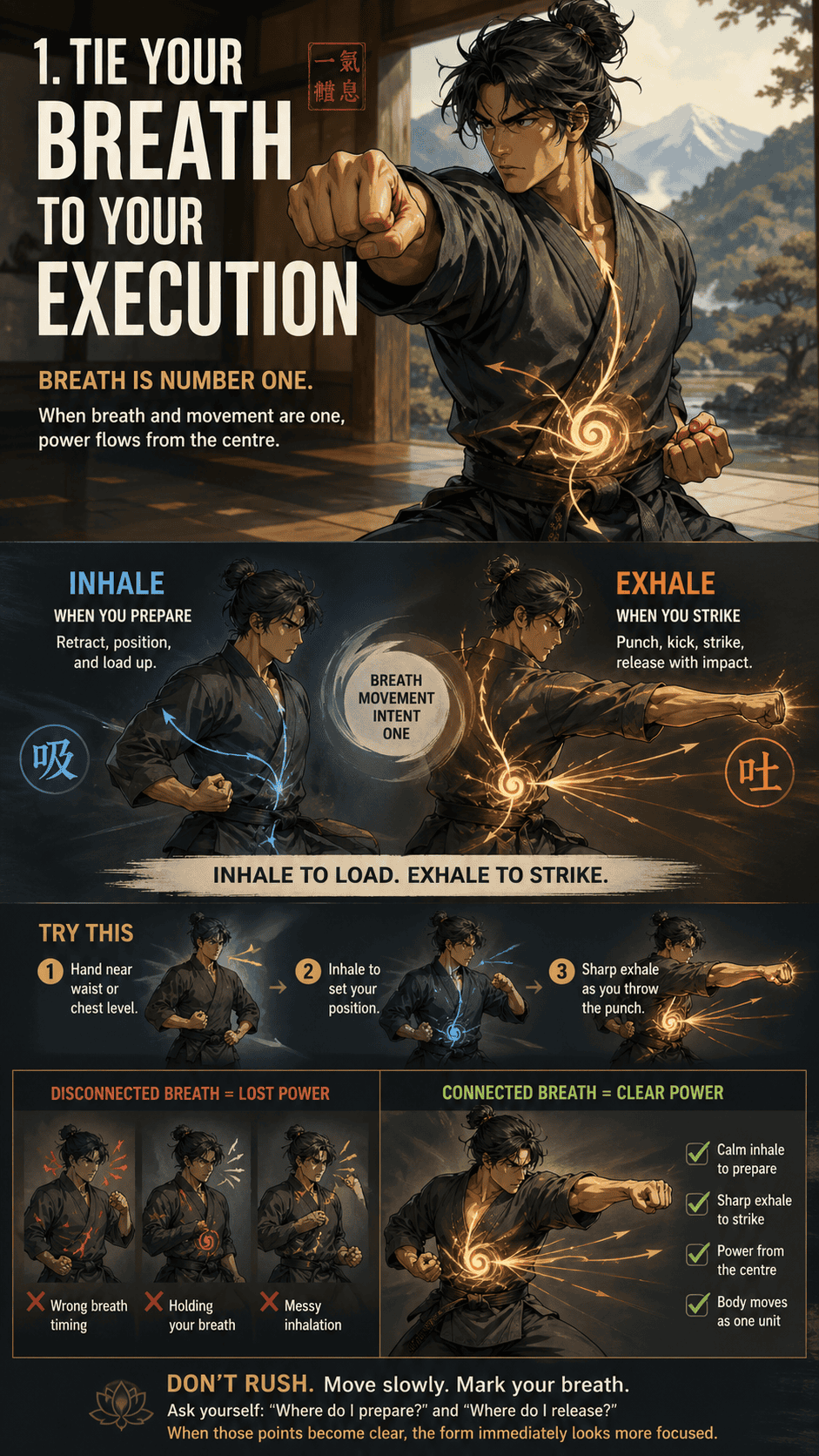
1. Tie Your Breath to Your Execution
Breathing is number one. Your movements should be tied to your breath, especially at the moment you attack. If you breathe out at the wrong time, hold your breath, or breathe in a messy way, the whole form looks distracted and the power doesn’t come through.
In all martial arts training, we often talk about delivering energy from the centre. Whether you describe it as “dantian,” body connection, or simply coordination, the idea is the same: your body must act as one unit, and breathing helps that happen.
A simple rule to start with:
- Inhale when you prepare: Retract, position, and load up.
- Exhale when you strike: Punch, kick, strike, or hit any moment that should land with impact.
To test this, put your hand near your waist or chest level, inhale to set your position, then do a sharp exhale as you throw a punch. Feel how the power travels through your body when the breath and movement match. Don’t rush through the set. Do it slowly at first and mark your breathing. Ask yourself: “Where do I prepare?” and “Where do I release?” When those points become clear, the form immediately looks more focused.
2. Drill Your Basics Individually
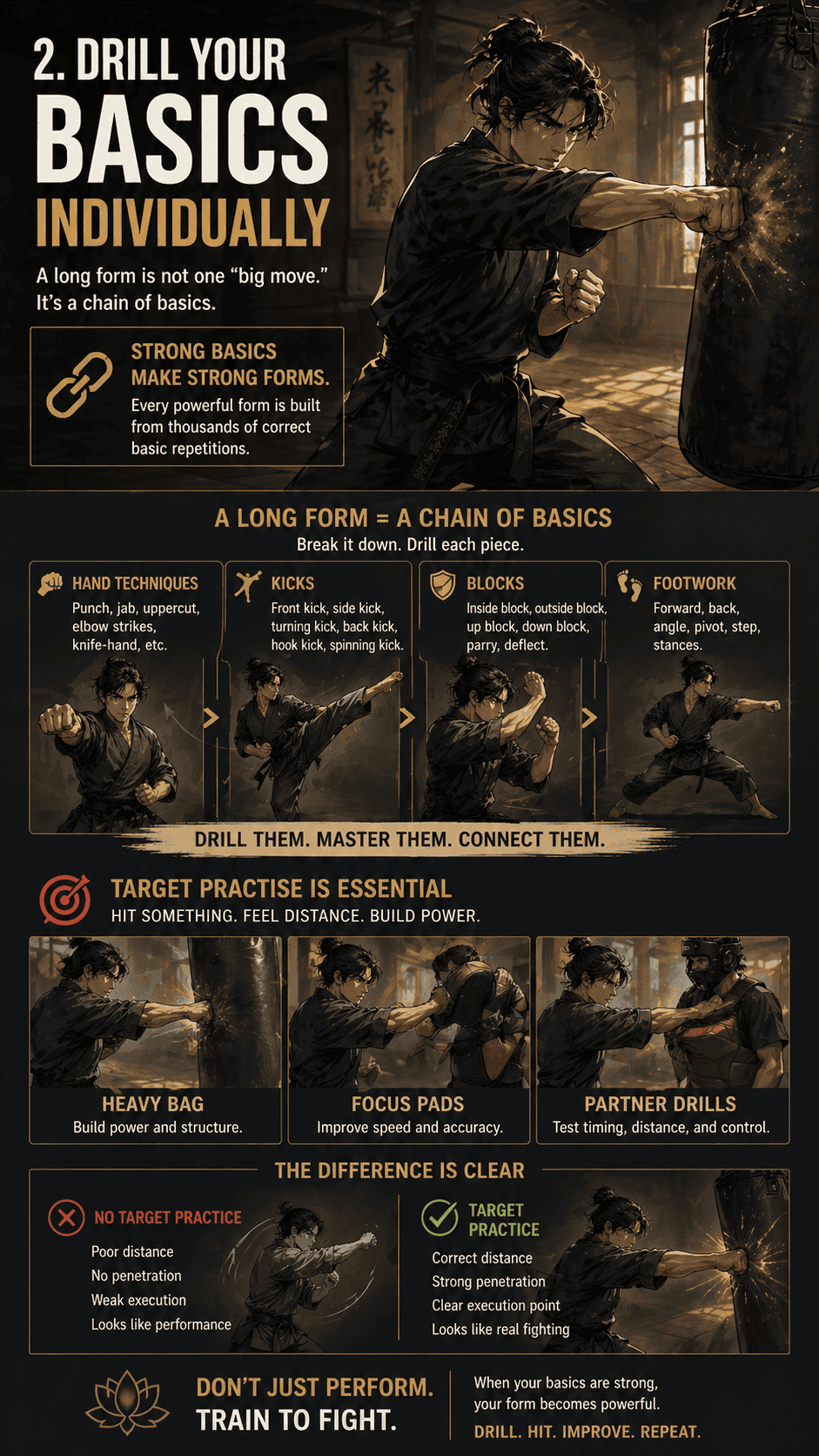
A long form is not one “big move.” It’s a chain of basics. Punches, elbow strikes, knife-hand, blocks, steps, kicks, these are single movements that got connected into a sequence.
If your basics are weak, your form will look like you’re floating through positions. If your basics are strong, even a simple section will look powerful. Break your form down into small pieces and drill them:
- Hand Techniques: Punch, jab, uppercut, elbow strikes, knife-hand, or any other strikes.
- Kicks: Front kick, side kick, turning kick, back kick, hook kick, spinning kick. (Even if your traditional set doesn’t use every kick, the training still builds understanding of power and balance).
- Target Practise: Most importantly, hit something. Use a pad, bag, or a partner with proper equipment.
If you never strike a target, you won’t fully learn distance, penetration, and power delivery. Without that, the “execution point” in your form will never be clear, and you’ll look like you’re performing shapes instead of fighting movements.
3. Give Purpose to Your Transitions
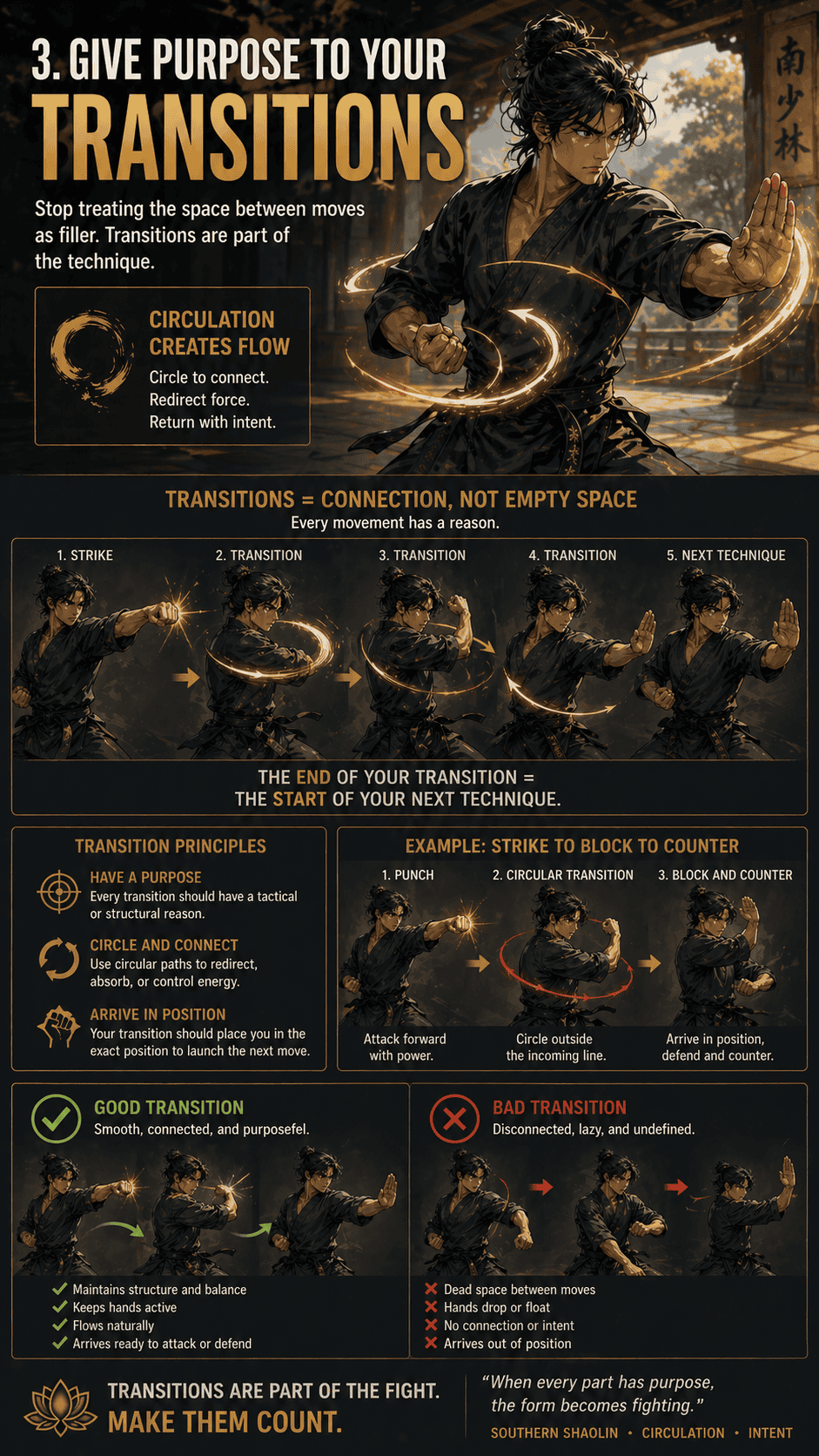
Stop ignoring the part between moves. In a long form, it’s common to focus only on the “big moments” and treat everything in between like filler. But the truth is: transitions are part of the technique. Your hand doesn’t magically turn from a punch into a block without a reason.
In Southern Shaolin, in fact most Southern Kung Fu styles, circulation is a key idea in transitions. After you strike, you may circle to connect into the next motion, especially if you’re imagining contact with an opponent’s force. A circular transition can represent redirecting incoming energy away from a critical line, then returning with a block or turning defence into offence.
If you’re ever unsure where your hand should be during a transition, use this guide: the end of your transition should place you at the beginning of the next technique. A strong punch doesn’t start at the moment your fist goes forward, it starts when the hand is chambered and aligned to launch. Your transition should bring you into that exact starting position.
4. Visualise the Attack and Distance
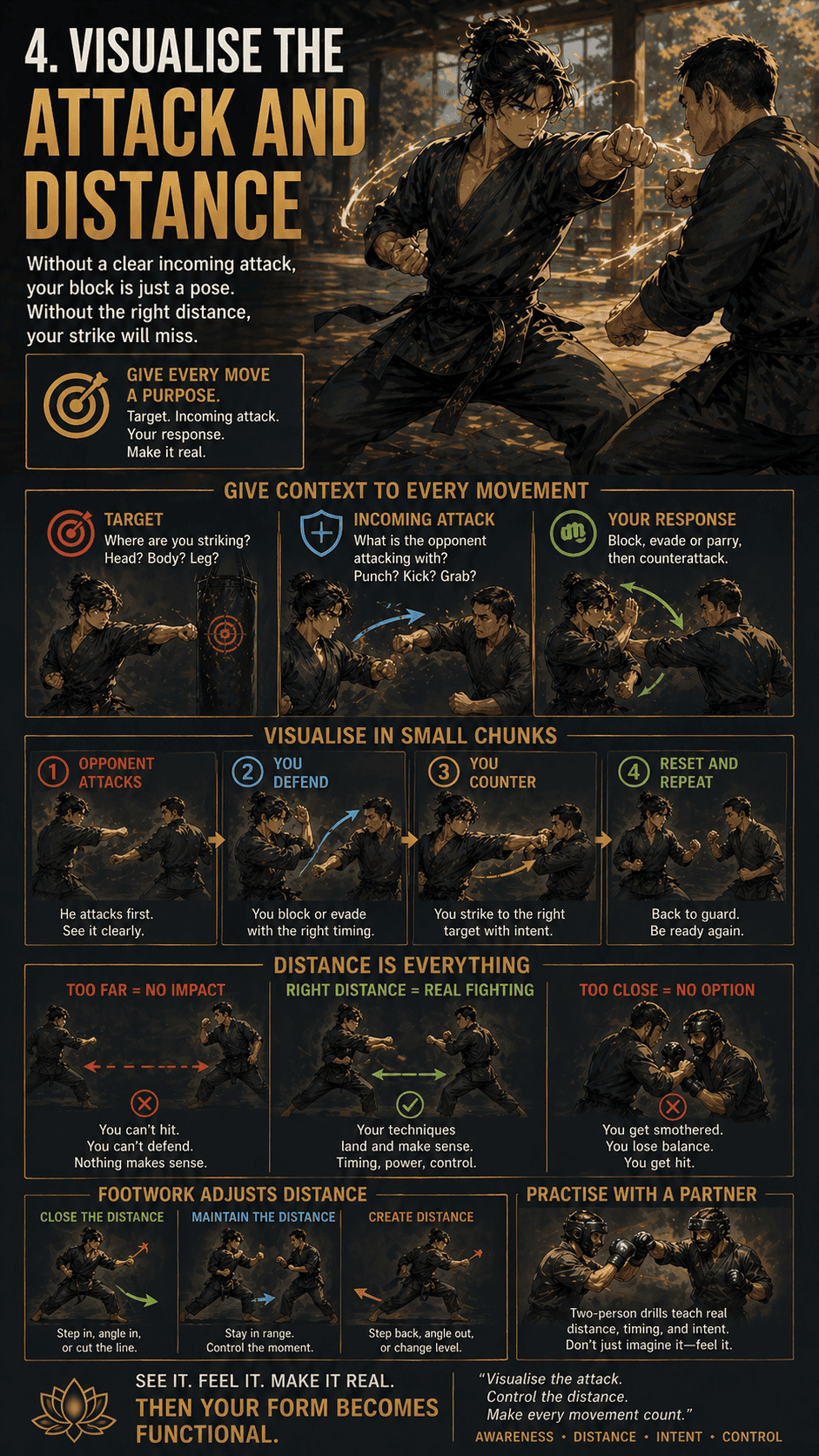
Just as I mentioned in my previous article about 'What does it really mean to know a kata'? You must visualise an opponent. Not in a fantasy way, but in a practical way. Without a clear “incoming attack,” your block becomes just a pose. Give every movement a specific context:
- Target: When you punch, where are you punching? Head, body, leg?
- Incoming Attack: What are you blocking? A punch to the face? A swing to the head? A grab?
Don’t imagine one opponent doing a perfect sequence that matches your entire form. Instead, visualise in small chunks. Opponent attacks, you block, you strike. That’s enough to make the section meaningful.
Distance is just as crucial. If your imaginary opponent is too far away, your strikes won’t make sense. Sometimes your opponent “moves back,” so you need footwork to close the distance. Other times you need to angle out. Practising parts of the form as a two-person drill will quickly teach you where the distance should be and why timing matters.
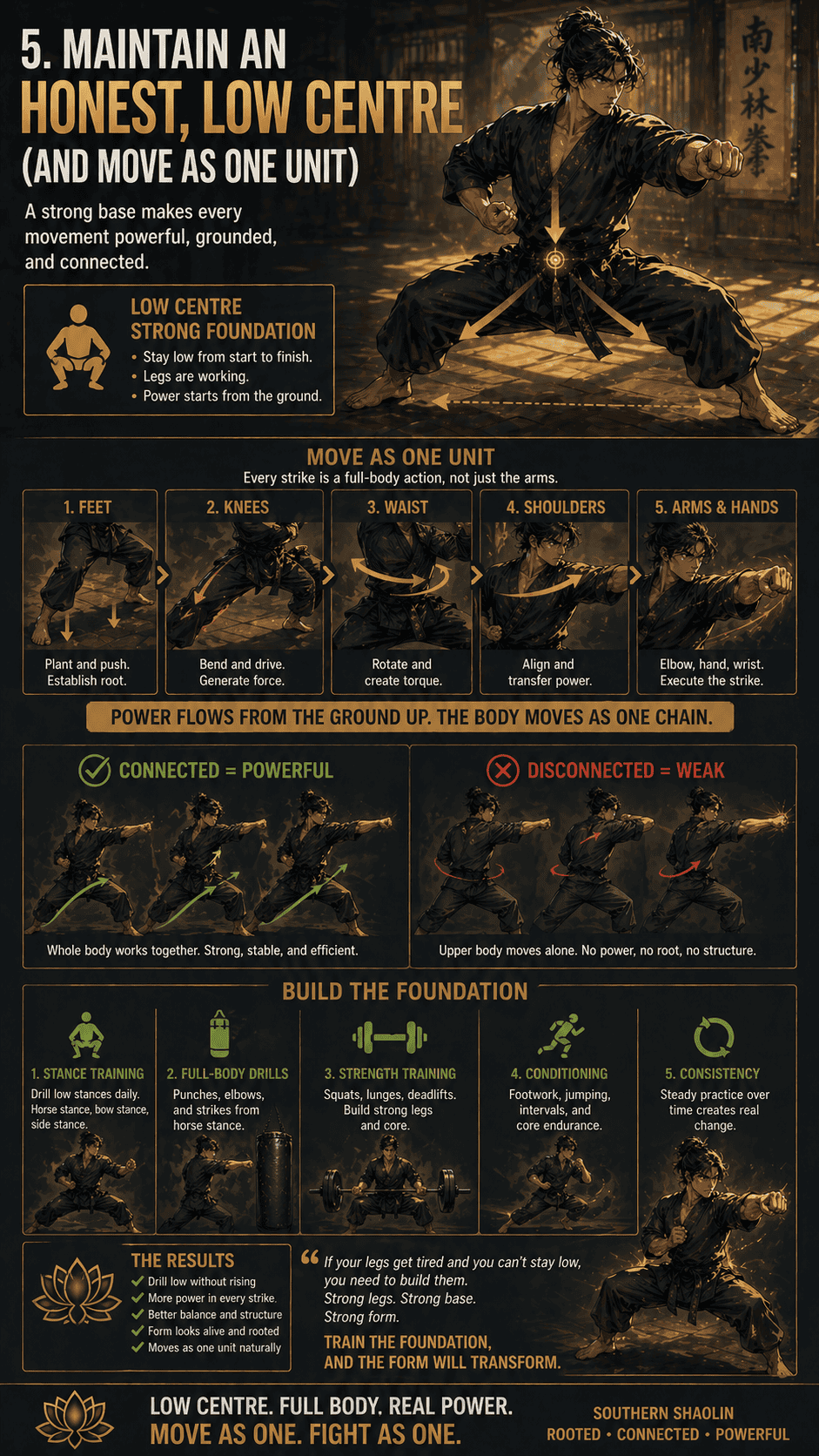
5. Maintain an Honest, Low Centre (and Move as One Unit)
Southern Shaolin has a strong conditioning element, and one of the clearest signs of real training is stance quality. If you start low and then slowly rise as the form goes on, your form loses its base. In stances like the shoulder-punch or horse stance, your legs should be working.
A stable, low centre makes your movements look grounded and powerful. However, staying low does not mean staying static. Moving the whole body is critical. Every time you deliver a punch, strike, or counter from that low base, your entire body must be involved in the motion.
Think of the movement as a connected chain. Even for a simple punch, the energy must travel from the ground up:
- Feet plant and push.
- Knees adjust and drive.
- Waist rotates to generate torque.
- Shoulders align and transfer the force.
- Elbows, hands, and wrists execute the final strike.
If your upper body moves while your lower body remains rigid, the form looks disconnected and loses its dynamic realism. Next time you practise a form, make sure that when you deliver something, even just a basic punch, the whole body moves together.
If your legs get tired and you can’t stay low while moving this way, you simply need to build the legs. Cross-training helps, spinning, basic strength work, and steady progression with weights. Drill low stances and basic full-body punches from a horse stance also helps. After a couple of months of consistent leg strengthening, your ability to stay low and move as one unit will improve, and your form will look completely different.
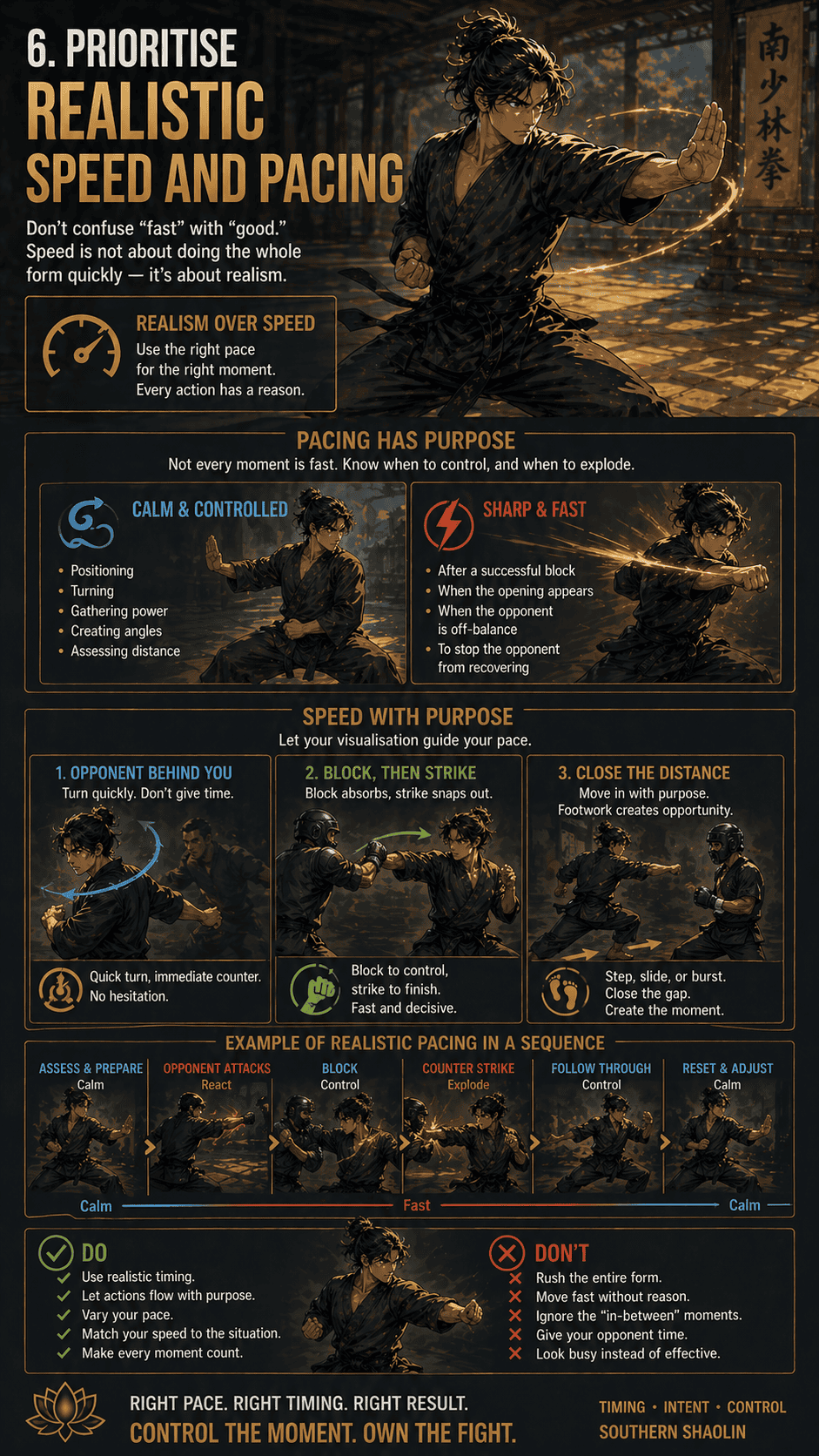
6. Prioritise Realistic Speed and Pacing
Don’t confuse “fast” with “good.” Speed is not about doing the whole form quickly, it’s about realism.
Some moments should be calm and controlled because you’re positioning, turning, or gathering power. Other moments must be sharp and fast, especially after a successful block, because in a real situation, you must counter before the opponent recovers. Use your visualisation to guide your pace:
- If the opponent is behind you, your turn should be quicker.
- If you block and then strike, the strike should snap out.
- If you need to close distance, your footwork should reflect that.
Expressing the Art
When you put these pieces together, breathing, basics, transitions, visualisation, a low centre, and realistic pacing, your form stops looking like memorised choreography. It starts looking like you understand what you’re doing.
Next time you practise, don’t just run the whole set and hope it improves. Pick one section and apply these points on purpose. Over time, the entire form will sharpen up, and people will be able to tell you’re not copying, you’re expressing the art.