
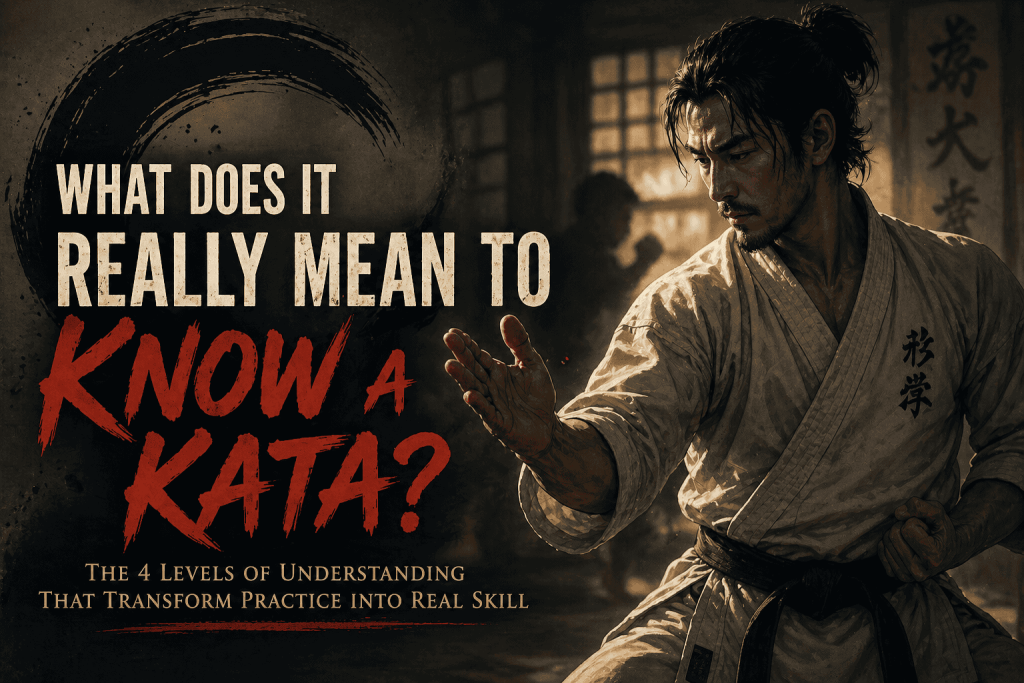
In martial arts, there is a question I frequently ask beginners: "Do you know this form? Do you know this kata?"
The answers I get almost always fall into one of two categories: "I don't know" or "I know." More often than not, the answer is "I know."
But here is the thing, when I dig a little deeper and ask crucial follow-up questions, the certainty disappears. I ask: "What does this movement apply to?" or "When can you use it?"
The responses tend to be vague, overly simplistic, or sometimes completely unrealistic. That confident "I know" turns out to be more of a surface-level familiarity than a genuine understanding of the kata or form.
Kata means “form,” and in some martial arts it’s simply called “form,” while in Japanese karate it’s usually referred to as kata.
This has led me to think carefully about what it truly means to "know" a kata. I believe there are four distinct levels of understanding, and most colour belts never move past the first two.
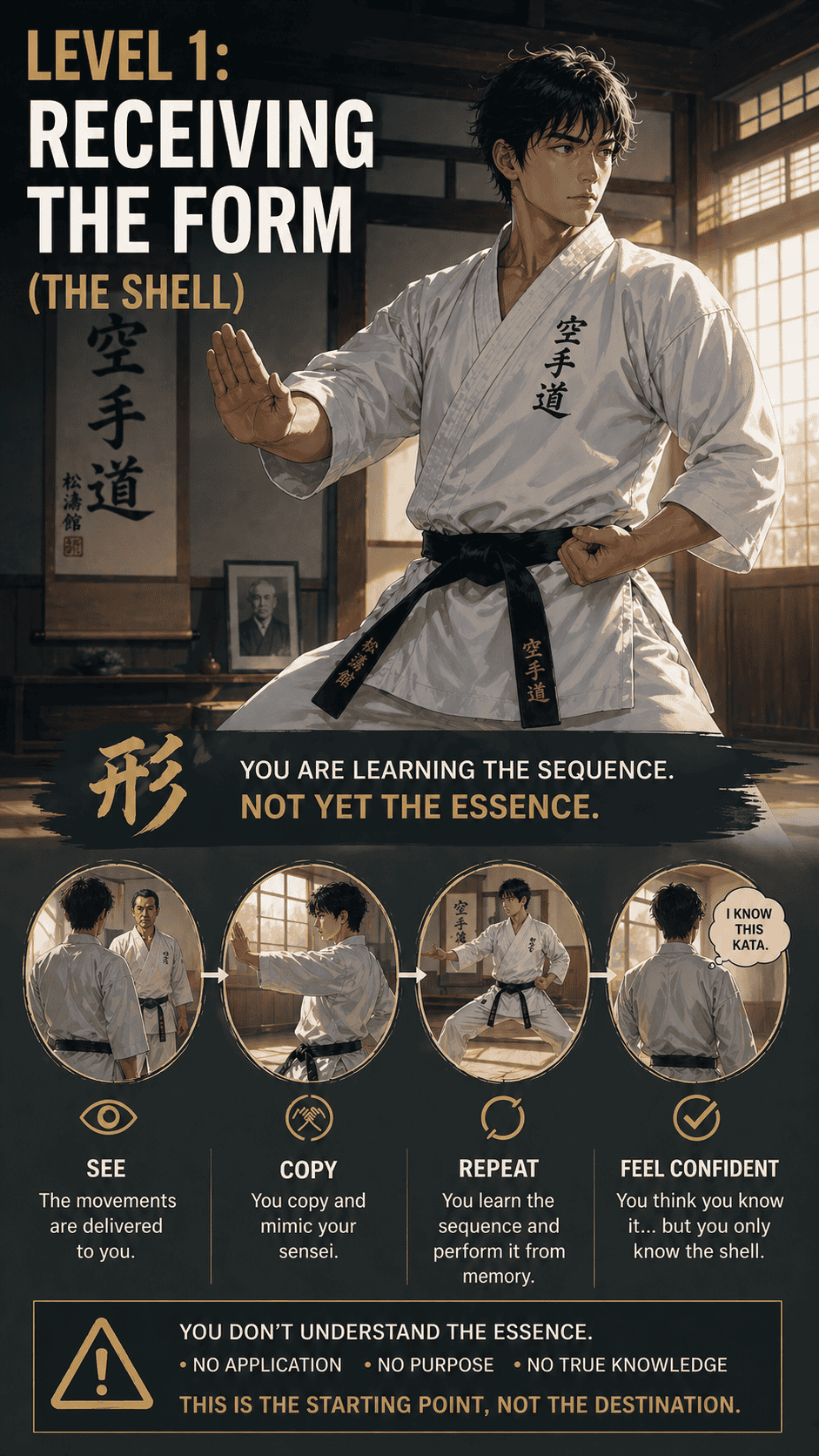
Level 1: Receiving the Form (The Shell)
The first level is what I call receiving the form. At this stage, the student is strictly focused on choreography.
- You are learning the sequence of movements.
- You are copying and mimicking your sifu or sensei.
- The movements are delivered to you, and you replicate what you see.
Once a student can perform the entire sequence from memory, they feel confident enough to say, "I know this kata." But in reality, they don't. They don't understand the essence of it, the applications behind it, or the deeper purpose of any given movement. They simply know the shell.
This is an essential starting point, but it is far from true knowledge.
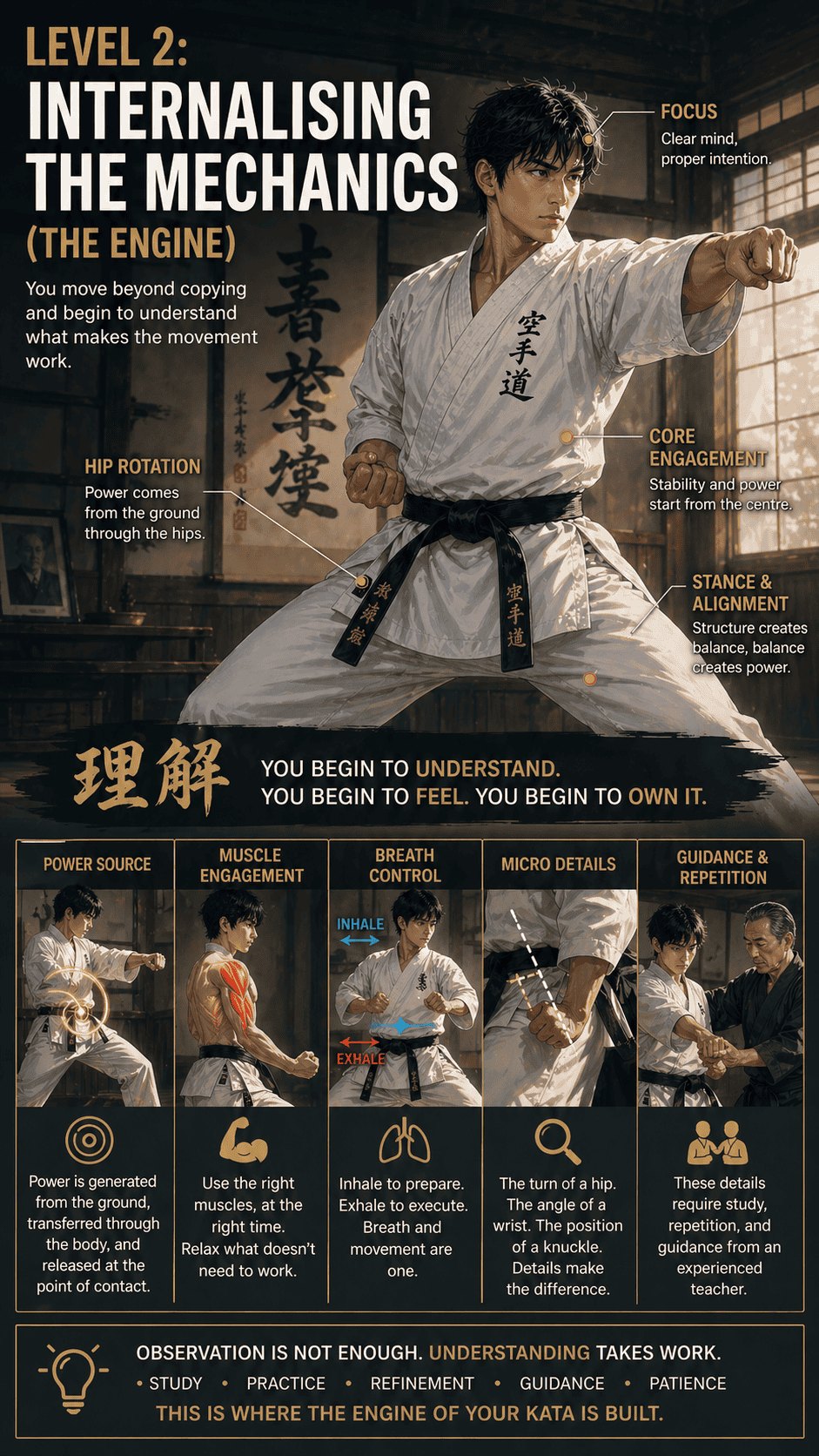
Level 2: Internalising the Mechanics (The Engine)
Level two is where real understanding begins to take shape. When a beginner mimics a form, countless small details get overlooked. These subtleties might seem minor, but they are what separate a movement that generates real power from one that looks the part but would fall apart in a real-life situation.
At this level, you move beyond mere copying and start to internalise the form. You must begin to grasp:
- Where power is generated.
- Which muscles should engage.
- Whether a movement requires an inhale or an exhale.
- Micro-details, like the exact turn of a hip or the angle of a wrist.
These details require dedicated study, repetition, and often direct guidance from an experienced teacher. They cannot be picked up through observation alone.
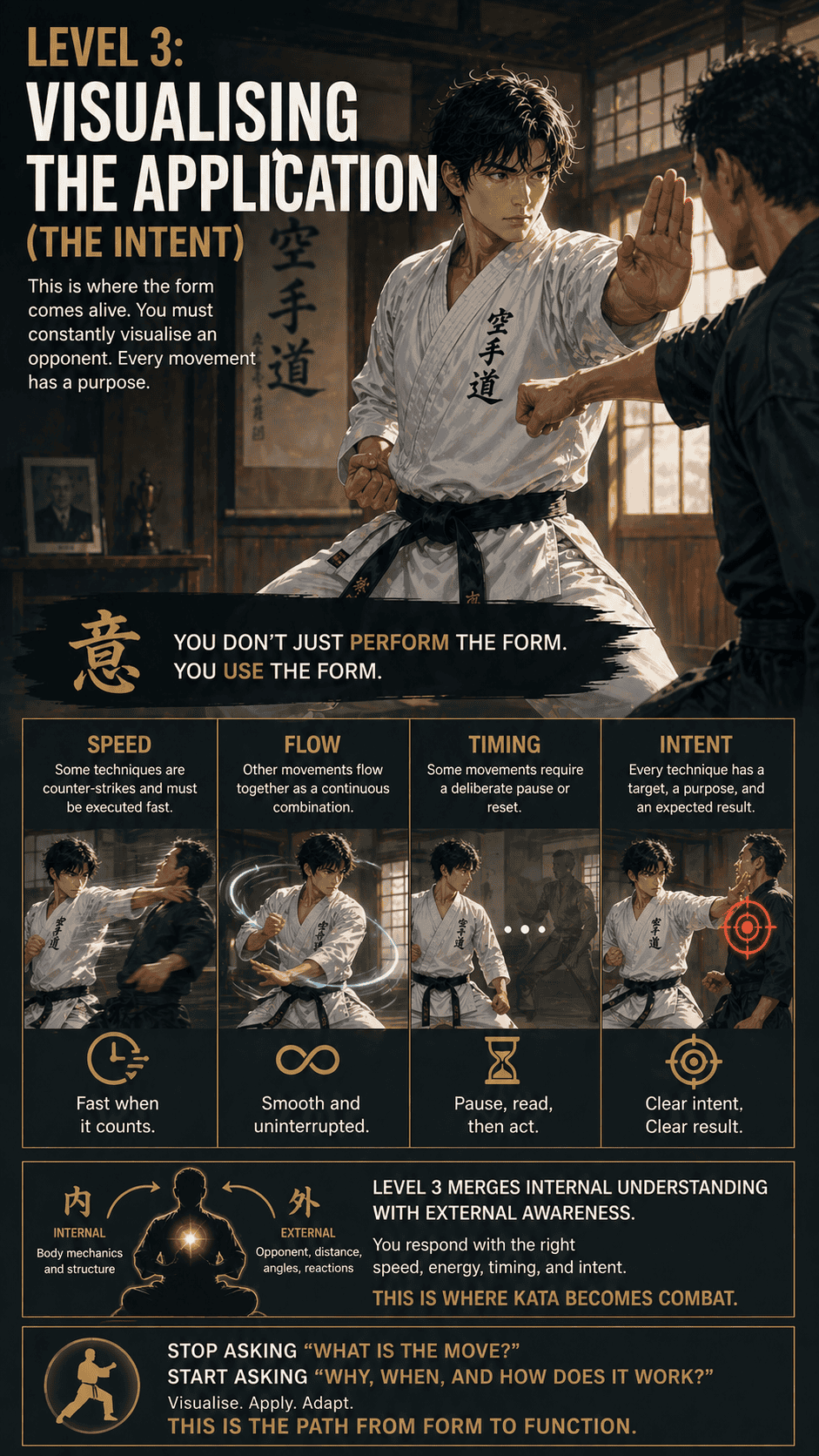
Level 3: Visualising the Application (The Intent)
Level three takes things into the practical realm. This is where the form starts to come alive. At this stage, you must begin to constantly visualise an opponent. It is not enough to perform a movement in isolation; you have to ask yourself, "Would this actually work?"
A student who only knows the movement as a movement will find that it probably would not work. This level demands specific intentional changes in execution:
- Speed: Certain techniques must be executed much faster because they are counter-strikes.
- Flow: Other movements flow together as a continuous combination.
- Timing: Some movements require a deliberate pause or a reset, because the form is transitioning into a different scenario or situation.
Level three merges your internal understanding (body mechanics) with an external awareness (the imagined opponent). You respond with appropriate speed, energy, timing, and intent.
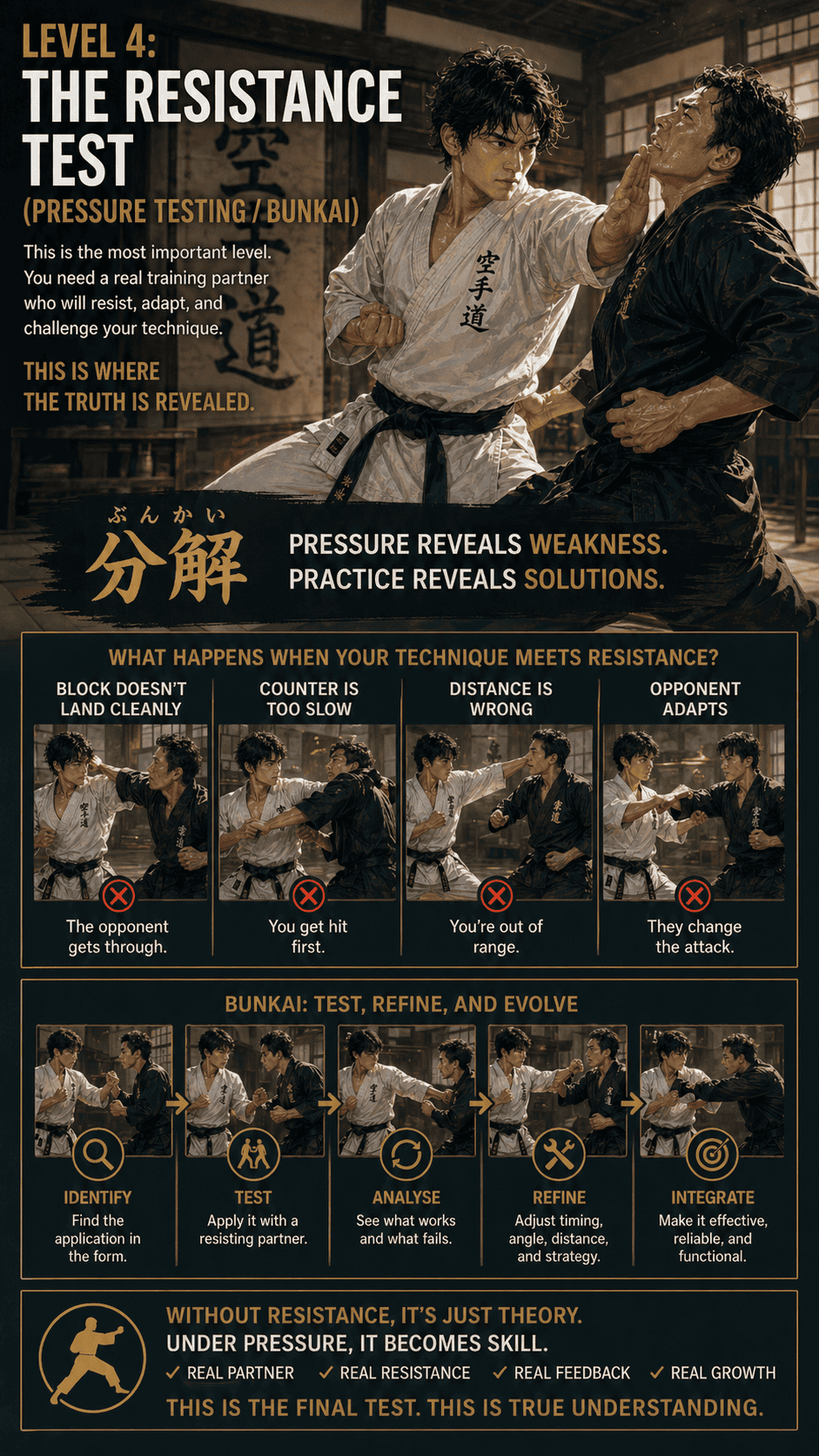
Level 4: The Resistance Test (Pressure Testing/Bunkai)
The fourth and final level is, in my opinion, the most important. It is also the one that many traditional martial arts, particularly those with forms containing hundreds of steps, fail to grasp or emphasise.
This is the resistance test.
You can practice a movement a thousand times, but visualisation alone is no longer sufficient. You need to know what happens when the opponent does not cooperate. What if your block followed by a counter-strike fails because the block did not land cleanly?
At this level, you need a real training partner, someone who will actively resist your technique, not simply go along with it. In traditional karate, this practice is known as bunkai. Without it, your understanding of a form remains theoretical at best, or limited to personal health and fitness benefits. You can never truly test the effectiveness of a technique without placing it under pressure in a resisting environment.
Conclusion
This is the journey of truly knowing a kata, from receiving the movements (Level 1), to understanding the mechanics (Level 2), to applying them practically (Level 3), and finally to pressure-testing them against resistance (Level 4).
Each level builds on the last, and skipping any one of them leaves massive gaps in your martial arts development. By continuously repeating, retesting, and refining through all four levels, students can deepen their understanding not just of a single form, but of martial arts as a whole.
So the next time someone asks you, "Do you know this kata?" take a moment before answering. Which level are you really at?