The Relationship Between Sports and Martial Arts
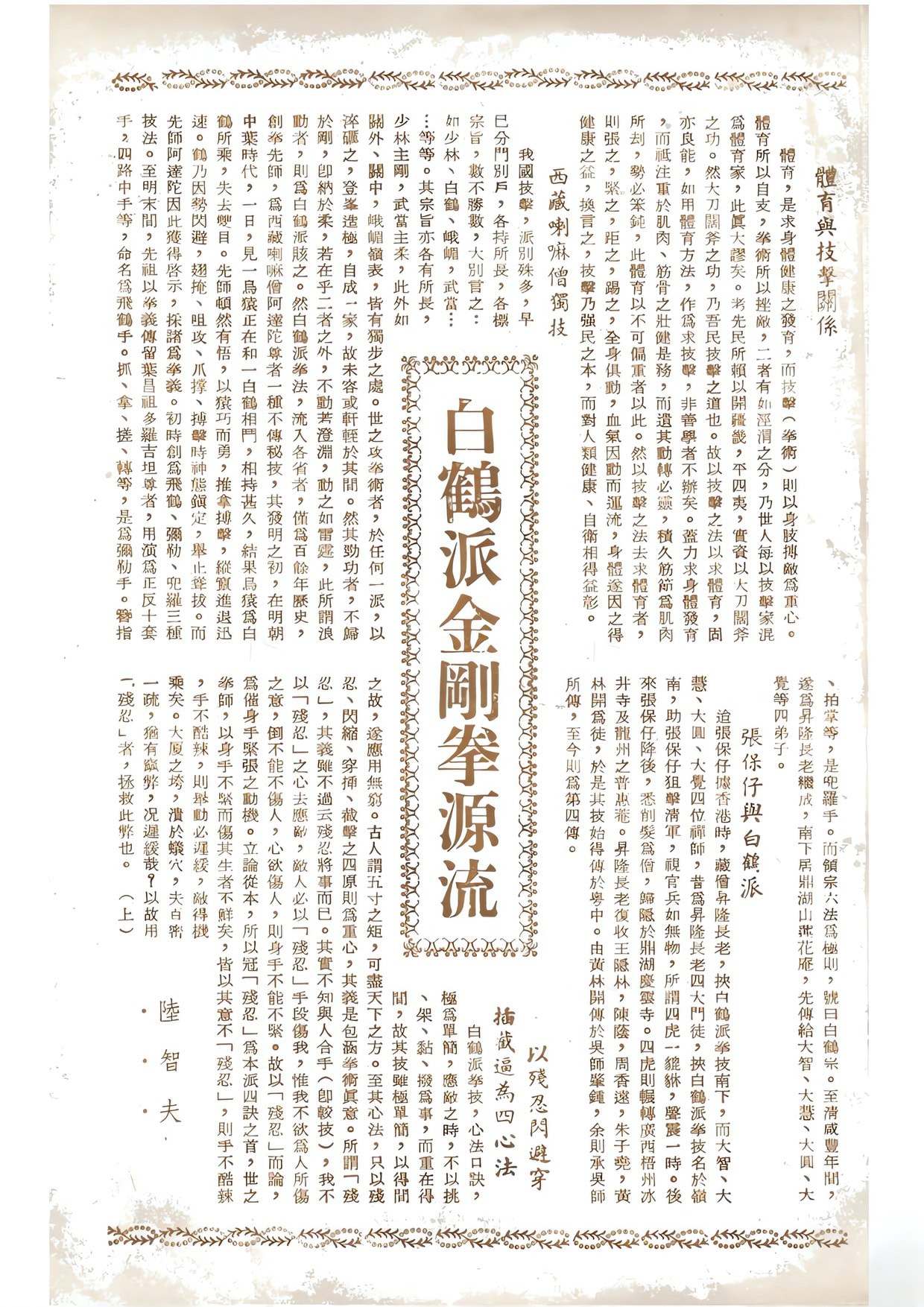
Sports pursues the healthy development of the body, while martial arts (combat techniques) focuses on using the body to fight enemies. Sports is for self-strengthening, while martial arts is for defeating opponents. There is a clear distinction between the two, yet people often confuse martial artists with athletes, which is a great error. Looking back at our ancestors' history of expanding territory and pacifying regions, they actually relied on swordsmanship and martial prowess. These sword and martial techniques are our nation's fighting arts. Therefore, using martial arts methods to train the body is certainly beneficial, but using sports methods to learn martial arts is difficult unless one is exceptionally talented at learning. This is because prolonged emphasis on physical development focuses only on muscle and bone strength while neglecting the necessity for flexible movement. Over time, the joints become constrained by muscle, inevitably becoming clumsy and slow. This is why sports training should not be overemphasized. However, using martial arts methods to train the body achieves stretching, tensing, kicking, and stomping—exercising the entire body. Blood and energy flow through movement, and the body gains health benefits. In other words, martial arts is the foundation for strengthening the nation and people, offering significant benefits for human health and self-defense.
The Unique Techniques of Tibetan Lama Monks
Our nation has numerous martial arts schools, long divided into different branches, each with their own strengths and principles, too many to count. Broadly categorized, there are: Shaolin (少林), White Crane (白鶴), Emei (峨嵋), Wudang (武當), and others. Each school has its distinctive characteristics—Shaolin emphasizes hardness, Wudang emphasizes softness, and schools from beyond the passes, central regions, and Emei mountain ranges all have their unique features. Those who study martial arts, regardless of which school they choose, can establish their own mastery if they study diligently and reach the pinnacle, so superiority cannot be judged lightly. However, each school's force technique is either hard or soft. If beyond these two, there exists a stillness like a deep abyss and movement like thunderous speed, this technique called "wave motion" (浪動) is the characteristic of White Crane style. White Crane boxing has only been spreading across provinces for over a hundred years. The founding ancestor was a secret technique not taught to outsiders by the Tibetan lama monk Venerable Adatuo (阿達陀尊者). When it was first created during the mid-Ming Dynasty, one day he witnessed a black ape fighting with a white crane. After a prolonged struggle, the black ape was defeated by the white crane and lost both eyes. The founder suddenly realized that although the ape was agile and fierce, skilled at grappling and striking, swift in leaping forward and retreating, the crane could dodge according to circumstances, using its wings to shield, beak to attack, and claws to grab and support. During combat, its demeanor was composed and its bearing upright. Adatuo gained inspiration from this and adopted these principles to create boxing techniques. Initially, he created three techniques: Flying Crane (飛鶴), Maitreya (彌勒), and Douluo (兜羅). By the late Ming period, the founder passed the techniques to Venerable Ye Changzu Duoluojitan (葉昌祖多羅吉坦尊者), who developed them into ten sets of forward and reverse hands, four paths of middle hands, and named them Flying Crane Hand. Grabbing, grasping, rubbing, and turning became Maitreya Hand. Finger techniques and palm slapping became Douluo Hand. With six methods as the highest standard, it was called the White Crane School. During the Qing Dynasty Xianfeng period, it was inherited and promoted by Elder Shenglong (昇隆長老), who moved south to reside at Guihua Nunnery (瑰花庵) on Dinghu Mountain (鼎湖山), first teaching four disciples: Dazhi (大智), Dahui (大慧), Dayuan (大圓), and Dajue (大覺).
Zhang Baozai and White Crane Style
When Zhang Baozai (張保仔) occupied Hong Kong, Tibetan monk Elder Shenglong brought White Crane techniques south, and the four Chan masters Dazhi, Dahui, Dayuan, and Dajue, who were Shenglong's four great disciples, became famous throughout Lingnan (嶺南) for their White Crane techniques. They assisted Zhang Baozai in ambushing Qing troops, treating government soldiers as nothing, the so-called "Four Tigers and One Pixiu" (四虎一貔貅), their fame shook the land. After Zhang Baozai's surrender, all shaved their heads and became monks, retiring to Qingyun Temple (慶雲寺) at Dinghu. The Four Tigers then moved to Bingjing Temple (冰井寺) in Wuzhou (梧州), Guangxi (廣西), and Puhui Nunnery (普惠庵) in Longzhou (龍州). Elder Shenglong later took Wang Yinlin (王隱林), Chen Yin (陳蔭), Zhou Xiangyuan (周香遠), Zhu Ziyao (朱子堯), and Huang Linkai (黃林開) as disciples, and thus this art began to spread in Guangdong (廣東). Huang Linkai passed it to my teacher Wu Zhaozhong (吳肇鍾), and I received the transmission from Teacher Wu, making this the fourth generation.
Ruthlessness, Evasion, Penetration, and Interception as the Four Core Principles
The mental formulas of White Crane boxing are extremely simple. When facing an enemy, one does not primarily use lifting, blocking, adhering, or deflecting, but rather emphasizes seizing the right moment. Therefore, while this art is very simple, because it excels at seizing opportunities, its applications are infinitely varied. The ancients said a five-inch ruler can draw all the squares in the world. As for mental methods, they focus only on these four core principles: ruthlessness (殘忍), evasion/contraction (閃縮), penetration (穿插), and interception (截擊), whose meanings encompass the true essence of boxing. The so-called "ruthlessness" seemingly means nothing more than having a cruel heart in handling matters. Actually, when engaging with an opponent (sparring), if I do not face the enemy with a "ruthless" mentality, the enemy will inevitably use "ruthless" means to harm me. Only if I do not wish to be harmed by others must I harm others, and if my mind intends to harm others, my hands cannot help but become tense. Therefore, "ruthlessness" is the motivation that drives physical tension. The principle begins from the foundation, which is why "ruthlessness" is listed as the first of our school's four secrets. Many martial artists in the world have lost their lives because their hands were not tense, all because their intent was not "ruthless" enough, meaning their techniques were not fierce enough. When techniques are not fierce enough, movements inevitably become slow, and the enemy can seize the opportunity. A mansion collapses from ant holes—even with a hundred precautions there will be one oversight and flaws will still exist, let alone when movements are slow. Therefore, using "ruthlessness" is to remedy this weakness.