
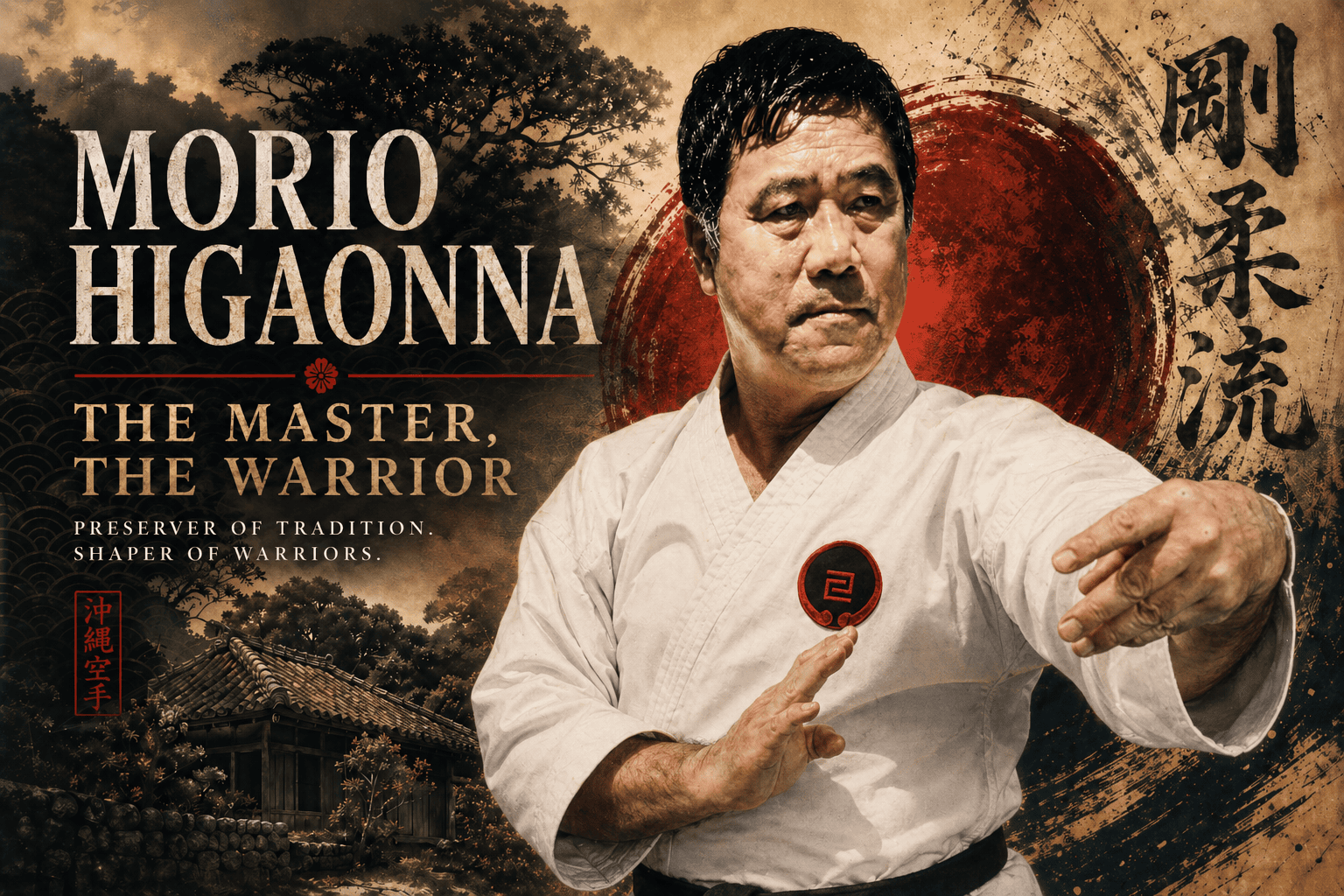
He is a master, he is a warrior, he is one of the most charismatic karate instructors in the entire world. Born in 1940, the son of a policeman, Sensei Higaonna’s amazing knowledge of both karate and Goju-ryu history has confounded practitioners from all styles and disciplines.
The chief instructor and founder of the International Goju Karate Federation, he has spread the teachings and traditions of original Grandmaster Chojun Miyagi to all corners of the world. His power, speed, and quick smile are second to none, and the calluses on his hands show his lethal devotion to karate-do.
From Okinawa to Japan, from Japan to California, and then back to the Far East again, Higaonna’s spirit has been forged in the fire of traditional karate training and shaped by the hammer of his intense will and dedication. Many other teachers do not hesitate to say that Higaonna’s students are the best all-around karateka in terms of respect, training spirit, and samurai cooperation.
He is a living example to all karate practitioners of how the art can shape a man into a warrior. His goal, though, has never been to glorify himself, but rather to preserve and perpetuate the traditional teachings he learned in Chojun Miyagi’s famous garden dojo.
Q: When did you start to train?
A: My father taught me the basic techniques of Shorinji-ryu, but he didn’t feel very comfortable doing so. Later on, I went to train under Shimabuku, not the famous Isshin-ryu master, and other teachers until I ended up with An’ichi Miyagi.
Q: There are some wild stories about you as a teenager.
A: I used to skip school and steal food. I’d rather spend the day at the beach than go to school. I was really shy, but also a difficult child.
Q: How were you introduced to Goju-ryu?
A: It was Shimabuku (島袋) who recommended Goju-ryu. He thought that, being stocky, I would fit very well into the style. So I started under An’ichi Miyagi, who was running Grandmaster Chojun Miyagi’s school, the original garden dojo. I fell in love with Goju-ryu on the very first day. I started to train up to six hours a day.
Q: What was An’ichi Miyagi like?
A: He started training under Grandmaster Miyagi right after the war in 1948. He joined the school with three other boys who, considering his weak body, expected him to quit right away. Yet An’ichi was the only one to stay and keep training at the dojo. Grandmaster Miyagi used to teach him the history of the art, the oral traditions, and the philosophy, but only after he had finished chores such as fixing the house and cleaning the garden. After the grandmaster’s death, his wife decided to keep the dojo open with An’ichi as the instructor. Later on, the garden dojo was closed and everyone moved to the new dojo named the Jundokan (順道館), operated by Ei’ichi Miyazato (宮里 栄一).
Q: Why did you leave Okinawa and go to Japan?
A: Master An’ichi joined the Merchant Marines and left the dojo to travel all over the world. I decided to move to Tokyo in order to study at Takushoku University (拓殖大学) and teach karate. A teacher there was one of my old classmates, Ryujo Aragaki. When he left, I took over the teaching. It was a great time for me, just teaching and training the whole day.
Q: Some say that An’ichi Sensei was only a child when he trained with Chojun Miyagi Sensei, that he learned only part of the system, and that his character was questionable.
A: If it wasn’t so funny, this would make me very angry. It’s also very ironic, but please let me explain this in detail and clarify it once and for all.
People seem unwilling to accept my word that my teacher is the little-known An’ichi Miyagi, yet they are willing to accept the claims of one of my former students that his teacher was Chojun Miyagi, the founder of Goju-ryu. This is despite the fact that he would have been barely more than an infant when Chojun Sensei died. They ignore the truth but accept the ludicrous.
The fact of the matter is very simple. When, full of nervous excitement and with the money my mother had given me clenched in my fist, I first went to the garden dojo of Chojun Miyagi Sensei as a boy of 16, I was told by Koshin Iha (伊波康進), a student of Chojun Miyagi Sensei, “If you want to train seriously, An’ichi will teach you.” He has taught me ever since; I have only ever had one teacher.
At first, I was not particularly impressed by An’ichi Sensei. Although his movements were very smooth and powerful, I was more impressed by the raw power of the younger students, Saburo Higa (比嘉 三郎) particularly. You could feel the rush of wind when he kicked and punched, and the physique he developed from Sanchin training was awe-inspiring.
It was only as I progressed and began to understand Chojun Miyagi Sensei’s Goju-ryu that I became aware of An’ichi Sensei’s mastery of it.
People should check their facts before they speak publicly. When Chojun Sensei died on October 8, 1953, An’ichi Sensei was in fact 22 years old; his birth date is February 9, 1931. His formative years, from 1948 until 1953, were spent in intense personal training with Chojun Sensei on a daily basis. At times, he was the founder’s only student. How better to learn Goju-ryu karate than to acquire it from the founder at a young age and spend the rest of your life perfecting your skill?
I know other instructors have claimed to be my primary teacher, and this is ridiculous. I know who taught me, and even now, when I need my kata checked, I return to the same source: An’ichi Miyagi. There is no doubt in my mind, so why should there be doubt in the minds of others?
Of course, when I started karate, all the senpai taught us. Training was very different then; it was more like an extended family arrangement, older brothers helping younger brothers. If you really stretch the point, all of them could say that they taught me. However, it’s true that others would offer their advice from time to time, even as I got older. For example, Miyazato (宮里) Sensei checked my Sanchin perhaps two or three times in all the years I was at the Jundokan, but my teacher was, and is, An’ichi Sensei.
I have to say that Miyazato Sensei was always kind to me personally, but he had a habit of saying unkind things about people behind their backs, which always made me feel uncomfortable.
Q: I was hoping that you would address the question of your training at the Jundokan after the garden dojo of Chojun Sensei closed.
A: It seems like only yesterday that An’ichi Sensei would call at my house and ask me to help him repair the makiwara (巻藁) at the Jundokan dojo, or clean up the yard and the equipment. It was at the Jundokan that An’ichi Sensei really started to teach me seriously. He explained to me every tiny detail he had learned from the founder about our method, and I was fascinated by his knowledge.
When I think of it, I experience again the thrill and excitement of my training in those days. An’ichi Sensei gave everything he had when training and expected us to do the same. Unfortunately, this led to disagreements with Miyazato Sensei. Miyazato Sensei felt that An’ichi Sensei was much too tough, and that his iron discipline, together with the physical demands he placed on students, would cost us members and therefore income.
Q: Why did you leave the Jundokan?
A: There were a number of reasons for leaving the Jundokan. An'ichi sensei was not shown the respect he deserved. Also, when Miyazato sensei would change details of the kata, An'ichi sensei would protest and a heated discussion would then take place, which was very unpleasant. I didn't like the board that was displayed publicly with the names of those who had not paid their dojo fees. I thought this was demeaning. And then there was the matter of the loan that was taken out to build the Jundokan. An'ichi sensei paid for the Jundokan building lot to be cleared with his own money and didn't expect to recover anything. However, the actual building costs were paid for by a loan guaranteed by Hamo Kochi, and this, I understand, was never repaid, which angered An'ichi sensei a great deal. He left to join the Merchant Marine, and the Jundokan changed a lot for me as a result, but I stayed on even after that for a while at least.
Q: Is this where the accusation came that An'ichi left Okinawa to avoid paying his debts?
A: Exactly! In fact, things were the other way around. He spent a lot of his own money on the Jundokan, then left to join the Merchant Marine in order to earn a decent living. Life was still very hard on Okinawa at that time. When the source of this allegation, that An'ichi sensei had left Okinawa to avoid paying his debts, was confronted recently, he denied saying anything of the sort!
Q: This allegation seems to have become something of a cultural tradition in Okinawan karate society. Gichin Funakoshi's (船越 義珍) critics claimed, also in the absence of any credible evidence, that he left Okinawa to avoid paying his debts. Perhaps this is an inevitable result of being a successful karate master, particularly if you train students that became internationally famous.
A: You may be right. An'ichi sensei told me that Miyazato sensei was upset when he heard that my Yoyogi (代々木) (Tokyo) dojo was busy because he assumed that I was making a lot of money. In fact, all the fees went to the owner of the dojo and I only received a small salary and a place to sleep. The salary was only paid for the days I taught. If I went away for a gasshuku (合宿), for example, I was not paid. I didn't realise what the problem was, or that there was a problem about money or anything else until in July 1981, when Ryosei Aragaki (新垣 遼成) asked me to come back to the Jundokan. I told him that I had made up my mind and I couldn't change it. Then in August 1981 at the championship in Osaka (大阪) I was asked to attend a meeting and was surprised to find Miyazato sensei there. He complained that when I went home to Okinawa I never went to see him. I really didn't understand what he was talking about as I had no reason to go and see him. While I respect him as a student of Chojun sensei, he wasn't my teacher or anything like that, and I really didn't know what to do under the circumstances. Mr. Arimoto (有本), who was also at the meeting, said that I should apologise to Miyazato sensei, so I did, and thought no more about it.
Q: I know that you have rather strong views on the subject of dan grades, but have publicly said very little. May we hear your opinion?
A: Dan grades have only become important because they cause so many problems. Chojun Miyagi sensei refused to award dan grades and the martial arts didn't have dan grades until judo adopted them. I was given third dan by Miyazato sensei at the first grading I attended when I was little more than a kid and it meant nothing to me, then or now. I never wore the belt. I agree that for students they are a way of measuring progress, but at a high price. They cause discontent, squabbles, and lead to excessive pride in self, which is the opposite of what martial arts training should develop in a student. Every one has different standards, so inevitably there are differences between the level of students from different dojo even when they have the same grade, and then the politics start. I believe that there should be black belts and white belts only, and that the focus should be on training, not on accumulating rank.
Q: On the subject of training, could you please tell me something about your own?
A: I am pleased to say my training has hardly changed over the years. Recently I started to study meditation with Sakiyama (崎山) sensei who is a famous Zen priest. Every day I run, practice hojo undo (補助運動), kata, and also meditation. My family is as supportive as ever so I am free to train for at least six hours each day. Of course, you must remember that physical training is just the gateway to mastery of the mind. That's why you must strive to achieve true humility through training. If you don't, it's difficult, if not impossible, to rise above the purely physical because your mind is forever clouded by thoughts of material things, pride and scorn for others, and similar negative feelings. Good karate makes good people, and I feel a responsibility to pass on what was given to me as a way of thanking my teacher, An'ichi Miyagi, and, hopefully, produce more good karate people by doing so. Because I teach so much I have a responsibility to train as hard as I can to pass on my knowledge in as pure a form as possible. If you do not train hard you should not teach!
Q: How is your training these days?
A: Good. I train quite a bit. When I was in Okinawa I didn't train as much as I would have liked to, but now I'm back to a lot of training and I feel really good. I do a long warm-up using some conditioning drills. Then I move into the hojo undo which are special exercises named chisi, sashi, and nigiri game. I train on the makiwara for over an hour, then move to kata training and the heavy bag. Three days per week I meet my instructor and we practice kata and free-sparring using gloves and headgear. I practice around three hours of kata per day.
Q: Do you teach what you train?
A: Karate teaching and training is not something easy. Everybody starts very passionately with lots of illusions, but due to the hard training only a few people continue. In the mid '60s karate was so popular that my classes were literally packed with students. I used to drill these students through kihon, but after a while not very many were left. In karate training, those who stick with it go through a process of self-analysis. They start questioning a lot of things about themselves and their reasons for training. The answer becomes a reflection of themselves. As a result, this leads to more focus, determination, and overall inner peace.
Q: As a teacher, did you have any problems adapting from the Japanese students' mindset to the American students' mentality?
A: Not really, but it is true that you have to know how to properly communicate with the different cultures. For instance, in Japan or Okinawa, people don't ask questions, they just repeat what you tell them to do. In the West, everyone wants to know "why," so you have to explain. That's the reason why I teach more applications in the West than I do back in Japan or Okinawa. Of course, once the student reaches the black belt level he doesn't need an explanation for everything. The problem in the West is that many people think of themselves as masters because they know kata applications when, in fact, they can't properly perform the kata itself because they waste too much time asking instead of doing.
Q: You traveled extensively in China in order to research the original training. What did you discover?
A: A lot of very interesting things! I contacted different Chinese masters who helped me to dig into the roots of the goju-ryu system. In one of my trips, the city mayor invited 15 or 16 old masters who performed kata from sanchin to suparimpei. We all agreed that our techniques had evolved from the Chinese white crane and tiger styles.
Q: Are the kata the same as the original Chinese?
A: Pretty much. I'm against changing kata. I believe that kata is not just something that someone made up. They are hundreds and thousands of years old. There is a lot of information in each one of them. Few people know that there are certain kata to be practiced in the morning and others to be performed in the evening in order to get the most from them. I understand that a lot of knowledge has been lost through the years but it is my responsibility to keep this important information alive for the generations to come.
Q: So you are against personal interpretations of kata?
A: I'm against changing the essence of kata. I always say that kata is like a printed letter. They are portraits of the basic techniques and history. If you change the essence of kata, you lose all this.
Q: If kata is a printed letter, what is kumite?
A: Kumite is handwriting, and everybody has their own penmanship! In sparring, you have an opponent and it's a little bit easier because you adapt to the movements of your adversary. In kata there is only space and time and you. There is no opponent, nothing to grasp, you have to imagine and aim for a spiritual opponent.
Q: Do you consider karate an art or a sport?
A: Karate is a martial art that uses no weapons. This doesn't mean that I reject the sport aspect since I feel that's one part of the whole art. However, karate is deep. If you simply retire after doing only competitions, and have strictly focused only on winning against an opponent, then karate has no meaning at all. Karate is for all your life. We can continue training until we are 70 or 80 years old. The real purpose of karate is not to beat someone or to win against someone. Karate is a pacifist philosophy of self-discovery.
Q: Why did you create the Okinawan Goju-Ryu Karate Federation?
A: My whole idea is to preserve the teachings and philosophy of Grandmaster Chojun Miyagi and spread them all over the world. That is why. It was not a matter of ego or power. I only want to protect and pass-on these teachings.
Q: You are very much into physical conditioning. Is the traditional method better than modern approaches such as weight training?
A: Not necessarily, but the traditional conditioning methods allow the practitioner to work the muscles in the body as a unit, not in an isolated way as weight training does. The traditional way was developed to help karate technique, so the training methods fit the karate structure and the way of moving the human body.
Q: Why do you train so much on the makiwara?
A: When we punch the makiwara, we are not only conditioning the knuckles but developing power, speed, and body coordination and punching mechanics. Everything comes together in makiwara training. On the other hand, if your body is not conditioned, it is very easy to hurt yourself when you hit someone. Just don't forget to start slowly and add power and increase speed as you improve in kihon.
Q: What does the term "do" mean to you?
A: Do is the way for the men. I never let passion or feelings rule my behaviour. I try to stay calm and face problems like Grandmaster Miyagi did in the Second World War. He didn't have any food at all, but yet he stayed calm. This is very hard to do, but it shows a lot about your spirit. Karate is spirit. Karate is life. Karate, for me, is like a cloud with nothing substantial to grab onto. You can do karate all your life and still find new meanings and new answers, that's why I practice every single day.
Q: Do you practice zazen (坐禅) and meditation?
A: Yes I do. For me, being focused on what I do every day is very important. I don't think about tomorrow when I train. I train today; I do my best today, then I'm happy. If tomorrow I'm alive when I wake up, then I will do the same thing. I try to be extremely concentrated on the "now."
Q: What do you expect from your students?
A: Everybody has different reasons to train karate. Some look for health, others for sport, and some for self-defense. There are many things yet to be discovered in goju-ryu. So I expect my students to keep researching the art so one day they can find the answers through their own personal investigation. Karate training has to be done with heart and sincerity. It brings your body and mind together. That's the real karate.
Chapter adapted from: Fraguas, J.M. (2007) Karate Masters Vol. 1. Santa Clarita: Empire Books, pp. 97–109