
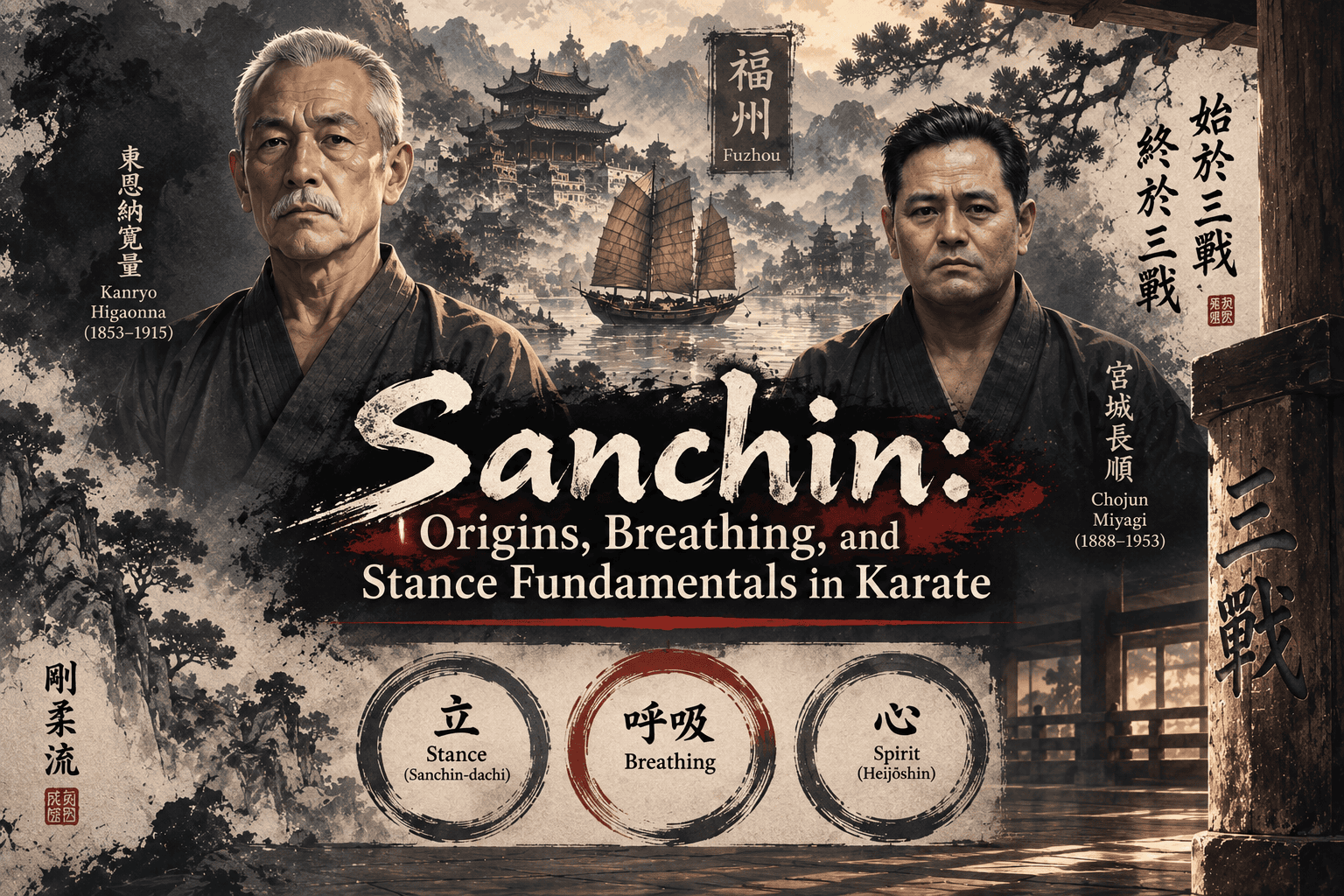
Begins with Sanchin, ends with Sanchin (始於三戰, 終於三戰) is a maxim constantly on the lips of those who practise Gōjū-ryū. Within its exceptionally straightforward movements, it is exceedingly difficult to grasp the subtle essence of this kata without appropriately coordinating the three elements of breath, muscle, and spirit. It can be said that this kata is both the fundamental of fundamentals and the most demanding kata within Gōjū-ryū.
The Origins of Sanchin
The original form of Sanchin kata was brought back from Fuzhou, China, by Master Kanryo Higaonna (1853–1915), the teacher of Gōjū-ryū’s founder, Master Chojun Miyagi.
In the 10th year of Meiji, at the age of 23, Master Higaonna sailed to Fuzhou, China, where he studied Chinese martial art for 15 years. Owing to his naturally robust physique, sharp martial intuition, and diligence far exceeding that of ordinary men, his martial reputation resounded not only across China but also reached across the sea to Okinawa.
Master Higaonna returned to Japan at the age of 38. Following his return, he initially concentrated on commerce for a period; however, compelled by the earnest pleas of senior peers and those who sought him out by reputation, he began taking on disciples to teach boxing. At that time, the very first kata he taught was ‘Sanchin’.
The Sanchin of that period differed from the kata practised today. Tradition holds that ‘at the time, open-hand spear-hands (nukite) were used throughout instead of the straight punch (seiken-tsuki). Later, Master Higaonna replaced the spear-hand with the clenched fist to suit the Okinawan physique and habits. It is said that the breathing method was likewise adapted for the same reason, shifting from short and rapid to slow and drawn-out.’ Such alterations to a kata could not have been accomplished without thorough, dedicated research. This demonstrates that Master Higaonna was not merely a martial artist, but an ardent martial arts researcher.
However, Master Higaonna’s pedagogical approach remained traditional (imposing intense mental and physical strain). Consequently, over the course of several years, among the numerous disciples who practised Sanchin kata alone, many either could not endure his severity or could not bear the monotony, giving up midway.
Only one or two disciples endowed with exceptional perseverance endured, and Master Higaonna instructed them unreservedly. Among these disciples was the man who would later become the founder of Gōjū-ryū, Master Chojun Miyagi (1888–1953). Master Miyagi entered Master Higaonna’s tutelage at the age of 14. Owing to his youth, superior endurance, and double the dedication of others, his skill advanced markedly. Master Higaonna doted on the young Miyagi as if he were his own son. In later years (the 4th year of Taishō), Master Miyagi journeyed to Fuzhou, China, to train in boxing, an endeavour largely influenced by Master Higaonna.
Master Miyagi was also the successor who continued the research into Sanchin kata. The footwork comprising three steps forward and three steps backward was devised by Master Miyagi. Prior to this, Master Higaonna’s footwork consisted of advancing three steps, turning round, and returning three steps. Today, I have inherited and mastered both the Higaonna ‘Sanchin’ and the Miyagi ‘Sanchin’.
From these facts, it is evident that the Sanchin kata transmitted within Gōjū-ryū today originated in China and was perfected through the dedicated refinements of both Master Higaonna and Master Miyagi.
The Fundamentals of Sanchin
Sanchin kata is composed of three fundamental elements: the stance (Sanchin-dachi), the breathing method, and the spirit. If any one of these three elements is lacking, one cannot master true Sanchin kata.
How, then, do these three elements relate to one another? Let us examine them from a martial arts perspective.
First, regarding Sanchin-dachi. The most critical aspect of this stance is tensing the muscles across the entire body. The ultimate state of Sanchin-dachi is one in which every corner of the body is brimming with energy (ki). In other words, practising Sanchin-dachi enables the body to withstand any blow and maintain a robust constitution. Furthermore, consistent daily practice of Sanchin-dachi yields measurable gains in muscular strength.
Next, the breathing method. The Sanchin method of inhaling slowly and exhaling slowly serves to sustain the muscular tension generated by Sanchin-dachi.
From a martial arts standpoint, ordinary everyday breathing is exceedingly dangerous. Why? Because during inhalation, the muscles throughout the body relax into a defenceless state. In contrast, the Sanchin breathing method maintains muscular tension whether one is inhaling or exhaling. Moreover, at the moment of an attack (the thrust in Sanchin kata), expelling a sharp, short breath—‘Hei!’—amplifies the power of the strike.
Governing both Sanchin-dachi and the breathing method is the ‘spirit’. ‘Spirit’ here denotes the required psychological state. For example, everyday anxieties or hesitations must not intrude during Sanchin practice. Anxiety or doubt causes lapses in the full-body muscular tension that ought to be maintained, while disrupting the respiratory rhythm. What, then, constitutes the correct state of mind? It is none other than heijōshin (an unruffled, ordinary mind). How can one preserve this composure and cultivate mental fortitude? The sole path is through patient, daily practice of Sanchin kata.
To clarify these three major elements further, the function and practical methods of their constituent parts are detailed below.
Sanchin-dachi (Hourglass Stance)
- Stride Width: Exactly equivalent to the distance from the knee to the heel. To measure this, bend one knee outward until it touches the toes of the other foot; this interval constitutes the correct stride width.
- Foot Positioning: The rear foot (left foot) points straight forward, with the line from the big toe to the heel extending directly ahead. The front foot has the heel turned outward and the toes pointing inward (see Figure 2). Force must be applied around the ankles so that the soles of both feet grip the ground firmly.
- Posture: Chest expanded, back straight, chin slightly tucked in, and both arms held in the morote chūdan yoko-uke (double middle-level side block) position. The elbows are bent at 90°, separated from the flanks by roughly the width of a fist. The fists rest slightly lower than shoulder height.
- Footwork (Unsoku-hō): When advancing, the centre of the moving foot must never leave the floor. Advance using suri-ashi (sliding footwork), tracing a semicircular arc inward. Step out with correct posture, contracting the anal sphincter inward before advancing. When retreating, follow the reverse principle. Pay particular attention to tightening both knees, the back muscles, and the gluteal muscles during retreat, centring awareness on the back.
Breathing Method
Breathing is coordinated primarily with the thrusting (tsuki), pulling (hiki), and blocking (uke) actions of the fists. Deep, drawn-out inhalations and exhalations are performed slowly to match the tempo of each technique. At the instant the thrust reaches its focus (kime), expel a sharp burst of breath: ‘Hei!’ The key is first to gather power deep within the throat, then exhale forcefully in a single breath, voicing ‘Hei!’ as you expel the air.
Throughout Sanchin kata, the respiratory rhythm generally remains uniform. Awareness must be focused entirely on balancing movement with breath.
Muscle Tension Methods
Muscular tension methods are divided into solo practice and partner-assisted practice. The sequence of muscular engagement differs between the two, as detailed below.
Solo Practice Method
- Direct the eyes straight ahead.
- Tuck the chin slightly inward (do not jut it forward).
- Drop all tension from the shoulders.
- Keep the back straight.
- Contract the latissimus dorsi.
- Draw both elbows in toward the flanks.
- Twist the forearms outward and clench the hands into tight fists.
- Contract the anal sphincter inward.
- Keep the soles of the feet planted firmly against the floor.
- Tension the upper limbs and both knees inward, once the upper limbs are tensed inward, expand them outward.
Partner-Assisted Practice Method
The partner pats, strikes, or pinches the practitioner using both hands according to the following sequence to draw their awareness to muscular tension:
- Slide fingers along the sides of both feet to verify that the soles are firmly flush with the floor, checking that force is applied through the soles.
- Grip both ankles with both hands to ensure tension is directed into the joints.
- Place both hands against the sides of the thighs and tap or prod with the fingers to verify engagement.
- Touch the gluteal muscles with the fingertips to confirm contraction.
- Apply light inward pressure from the outer sides of the buttocks with both palms, prompting the practitioner to tighten the anal sphincter.
- Tap the tanden (lower abdomen) lightly to ensure engagement.
- Press the chest and abdomen with the thumbs to verify firmness. (Exercise caution around the neck area.)
- Run both hands along the spinal column to confirm it is straight.
- Prod across the entire back with the fingertips to confirm engagement.
- Press around the shoulder blades with the thumbs to verify tension.
- Stroke the cervical spine with both hands to confirm muscular firmness.
- Pat the shoulders lightly with the palms, followed by firmer strikes, to verify muscular tone.
- Correct the overall posture of the entire body.
- Check thrusts by bracing back against them with an open palm; test middle blocks using hooking blocks (kake-uke), confirming whether power is concentrated into the techniques.
- When the practitioner drives out both palms using the tiger-mouth grip (toraguchi), meet them palm-to-palm to confirm whether power is focused.
Sanchin is a core practice in Okinawan Goju Ryu Karate, tracing its origins back to China. It’s no coincidence that the same training method has been used in the Shaolin Temple for hard-breathing Qi Gong to build strength and muscle endurance. Similar conditioning methods in Shaolin share this common root. Practicing Sanchin daily, sometimes with weights in hand, can greatly enhance muscle strength. Sanchin kata is linked to the element of wood, emphasising the importance of rooting. There’s also a partner drill to test rooting: three people are involved, with the main practitioner in the middle performing Sanchin without moving their feet, while maintaining breathing and hand movements. One partner uses a belt to pull one leg, the other does the same with the other leg. Gradually increasing the force tests if the practitioner can stay rooted. The drill can be repeated pulling in the opposite direction, with each person taking turns in the middle.